Showing posts with label needScottnumber. Show all posts

Tuesday, January 31, 2023

Canada Prince and Princess 2011


Canada issued the two version of this pane in 2011 for the royal wedding. The only different difference seems to be the presence of a crest (or not) in the supper portion. The stamp features the royal couple, some verbiage, and a picture of the interior of the cathedral. There is some verbiage and a barcode lower on the front. The case of the organ in the facility happens to make it into the image. The stamps are not summed, 

Saturday, January 28, 2023

Guinea-Bissau, Mozart Memorial


Guinea-Bissau issued this stamp in honor of the birth of Amadeus Mozart in 2016, the 260th anniversary of his birth. The stamp pictures a musical salon scene with participants/listeners and perhaps a clergyperson in the rear of the scene.  In the background is an inset picture of Mozart which includes an image of a pipe organ. Another performer is playing an additional keyboard instrument, a piano or harpsichord perhaps. The stamp seems to show a fairly specific organ, though I cannot determine what instrument it may be. I would be happy to hear suggestions. 

Friday, January 27, 2023

Guinea-Bissau: Bach Anniversary


Guinea-Bissau issued this stamp in 2010 to mark the 260th anniversary of the death of JS Bach. The stamp is a single high-value stamp, issued along with a set of five smaller stamps of the composer with various musical instrument, in various poses and in various denominations (not shown). There does not appear to be any specific connection between the composer, and anyone related to Guinea-Bissa. The stamp includes an image of the composer in profiles, and a second contrasting image. In the latter, the composer is seated at an organ console.  In the background is a portion of a console-style piano which would not be appropriate for the time period of the composer. There is some manner of crest near the composer; someone more versed in the topic may know if it's accurate or not. 

Monday, January 25, 2021

Poland: Olkusz


The most recent issue in Poland's "historic organs" series shows the instrument in st Andrew's Basilica in Olkusz. This stamp was issued in the latter half of 2019. It is in a similar format to other stamps in the series.  The instrument was built by Jan Hummel and his apprentice Jerzy Notrowski in the early 1600's. By 1972 the organ was not playable, and a long series of improvement projects was begun. This Polish organ site gives great details about the instrument, including specifications and photographs. the level of research that has gone into the reconstruction of the instrument is laudable. I must thank my friend Mark Jameson who has generously shared with me copies of the stamps, various FDC's, and some of the large folios the Polish post office has prepared related to the stamps in this series.


Poland: St John, Torun


Poland continued its "historical organs" series with two stamps in 2019. The first to be issued was for Torun Cathedral. Similar to others in the series, there is a single large format stamp in a mini-sheet. The cathedral church of St John the Baptist and John the Evangelist contains two instruments. The smaller of the two is shown on the stamp. It's believed that an instrument was in place by 1497. A new instrument was installed in 1688. Work was done on this instrument over many years though it remains mostly as it was installed. This site provides good details, the stoplist as it has evolved over the years, and several helpful pictures. The stamp was issued 21 June 2019.


Friday, January 15, 2021

Malaysia: St George's Church Pupua Pinang


The Malaysian postal service issued this stamp celebrating the St George Anglican Church in Georgetown (Pulau Pinang, or just Pinang, or Penang) in 2019. It is part of a series of stamps noting various religious structures in that nation. The stamp shows the iconic exterior of the facility; the selvage includes an image of a new pipe organ by the Mander firm of Great Britain.Pinang may refer to the Malaysian state, Pinang, or to the Pinang Island, though they appear to be essentially one and the same. The church is the largest in South-East Asia.

The British East India Company seized the bit of land that includes Georgetown in the late 1700's. It was a British enclave that affected British characteristics for many years. The church of St George was begun in 1815 and consecrated in 1819. A pavilion was erected in 1886 in the lawn in front of the west end doors.

A new organ was installed by the Mander firm in 2018. The firm's website give s bit more history: the church was built by Indian convict laborers. The building was bombed in 1941 and looted. It was restored and re-opened in 1948. The first organ was a second-hand Bryceson instrument originally serving a church in Singapore. That was replaced in 1899 by a Forster and Andrews instrument. That organ received some work in 1931, but was then destroyed in the 1941 bombing. Electronic instruments served the church until 2017. The area in which the church is situated was declared a UNESCO World Heritage Site in 2008, and major restoration of the church was done again in 2009. 

The Mander site gives some interesting details about the placement of the instrument in the church, as well as specification. 

The sheet of stamps has 20 stamps arranged in four columns of five stamps each. There is narrow selvage on all sides, and a wider selvage dividing the four columns in the center. The organ, and church steeple, are shown there. Other religious buildings appear in the outer selvage. The stamps include an indication "4/5." I have not investigated yet, but I suspect that may relate to the stamps appearing in the series being produced by the postal authorities. 


Great Britain: Hampton Court Palace


In 2018 Great Britain issued a set of stamps celebrating the Hampton Court Palace, most strongly associated with King Henry VIII. Six stamps show views of the exterior of the building, and two landscape shots. A mini-sheet of 4 stamps shows interior views. Shown inside are the Great Hall, the King's Bedchamber, the Chapel Royal, and King's Staircase. Two of these stamps pay the FirstClass postage rate, and two of the stamps are denominated 1.45 British pounds. The chapel image includes the facade of the organ contained therein. The first organ in the chapel was installed in 1711-1712, built by Christopher Schrider. Harrison and Harrison Ltd did the most recent work on the instrument in 2013. The current instrument is contained in the case for the original Schrider instrument, built by Grinling Gibbons.

https://www.chapelroyalhamptoncourt.org.uk/the-organ/


Guinea: German and Austrian Composers


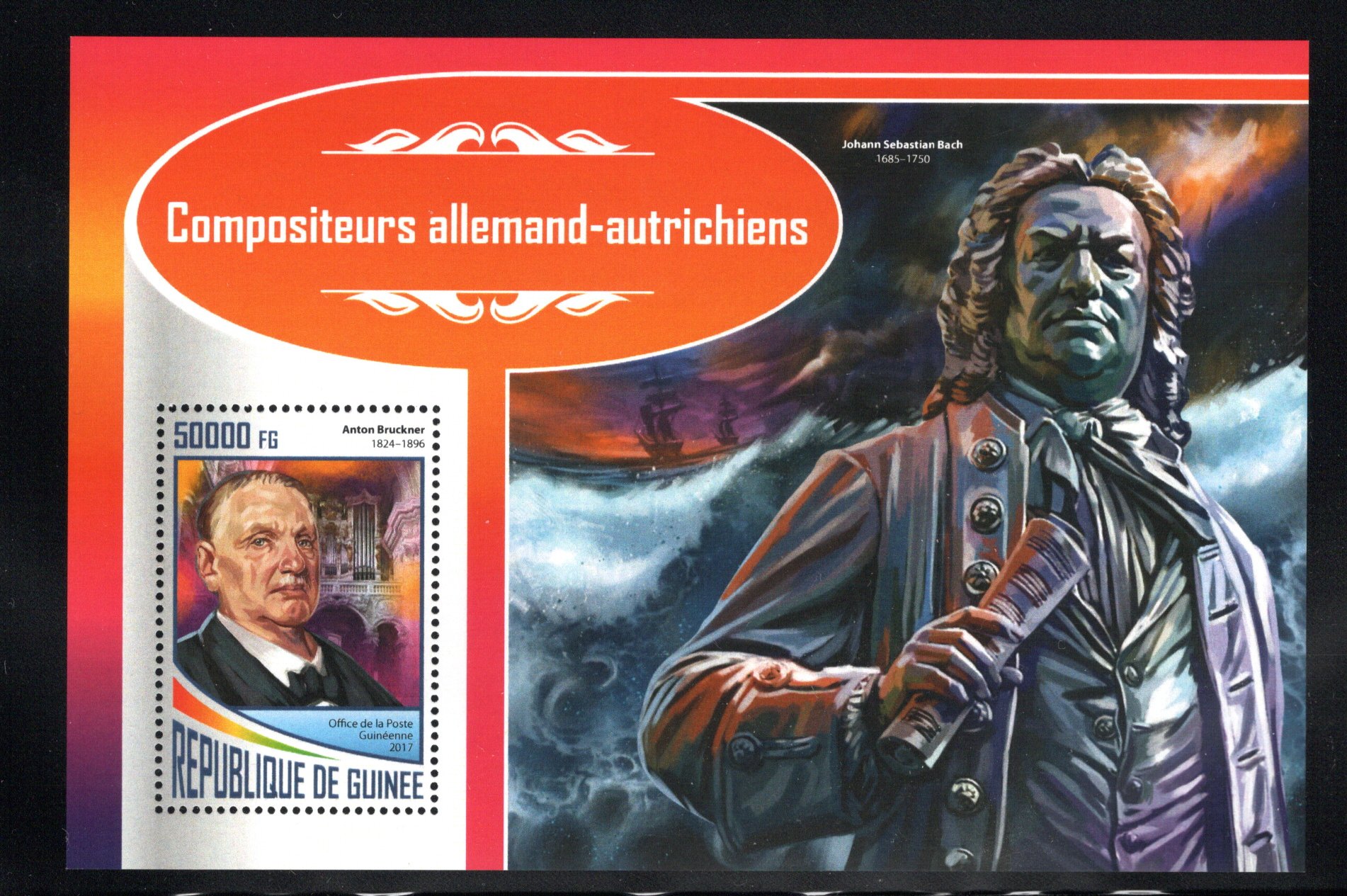
Guinea issued a mini-sheet and a sheetlet of four stamps commemorating German and Austrian composers in 2017. The sheet of four stamps includes images of Beethoven, Mozart, Haydn and Schubert. The mini-sheet shows Anton Bruckner. An organ is in the background of the Bruckner stamp.

European colonizers divvied up the African continent savagely in previous centuries. Portugal, France and Spain all laid claim to areas that included the name "Guinea." The region was a major source for gold which is why it was important to the colonizers. After the various colonies gained independence they took various names: the Spanish region became Equatorial Guinea, the Portuguese region became Guinea-Bissau; French Guinea became simply Guinea. Thus these stamps are from the formerly French region, and include French on the stamps and use francs for the denominations.

Anton Bruckner is closely associated with the St Florian Church in Austria. He has been interred in the church's crypt since his death. The organ pictured on the stamp seems to be that of the St Florian church. Rather than a larger picture of Bruckner in the selvage of the sheet as is often done with this sort of stamp issue, an image of JS Bach is shown.

The organ was built in the 16th century by Franz Xavier Chrismann of Slovenia. It presently has more than 7000 pipes.


Saturday, March 21, 2020

Sweden: Christian art


Sweden issued a set of 5 stamps in 2014 commemorating 1000 years of Christian art. Two copies of each stamp appear in a single strip in a foldable booklet.


The second of the five stamps shows an angel from the 17th century pulpit in Brahekyrkan (Vaxjo Diocese, Smaland) and the 18th centuary organ in Askeryd's Church, also in Smaland.

http://www.filateli.info/nya_frimarken/2014/sverige_20140508_kyrklig-konst.php

The Askeryds Church is an ancient facility near Aneby within the state church of Sweden's (broadly Lutheran) Linkoping Diocese. This site (below) gives some general history of the church but includes remarkable details about the organ. Reading a translation of the Swedish gives mixed results: equal measures of clarity and confusion. The church dates from the 13th century. An organ is first mentioned in church records from 1590. An organ of 1 manual by Wistenius was installed in the west gallery in 1760. Pedals were added in 1770. The instrument was relegated to un-use by 1905 in favor of an instrument Zetterquist in one of the transepts. Ultimately the Zetterquist organ was moved to the gallery and the Wistenius organ was placed on the main floor in a transept. Frobenius (Denmark) restored the Wistenius organ 1961-1962. Frobenius does not list the work they did on this organ on their website, presumably because it was restoration work rather than a new instrument.

https://sv.wikipedia.org/wiki/Askeryds_kyrka

http://askeryd.se/Askeryd%20kyrka.htm


Zetterquistorgeln från 1906 på orgelläktaren i västra delen av långhuset.  Läktaren flyttades fram isamband med att man flyttade upp orgeln


The Zetterquist organ from 1906 on the organ bar in the western part of the longhouse. The stand was moved forward in connection with moving the organ up

https://jonkopingslansmuseum.se/wp-content/uploads/2018/01/Askeryds-ka.pdf

Below are images showing the exterior of the booklet, including some of the descriptive material they provide. Also the interior with its information about the stamp run and the subject.


Friday, March 20, 2020

Romania: Buchhholz Organ


Romania issued this stamp in 2016. It was the third in a set commemorating Romanian "curiosities and superlatives." The instrument was built by Carol Buchholz in 1869 for the Black Church in Brasov, Romania. Renovations were done in 1966 including some stop changes, but these were un-done in 2003. I was able to find a stoplist within a database maintained by the Lutheran Church in Romania. The other two links below give some narrative history of the church and organ. I blogged about Daniel Croner and his relationship with this organ here. Since writing that post I have secured a handful of small-scale pieces by him.


http://www.sonusparadisi.cz/en/organs/germany/bra.html

https://www.honterusgemeinde.ro/die-schwarze-kirche/orgeln/

http://orgeldatei.evang.ro/organ/view/1230


Germany: Titanic organ


Titanic-Untergang mythos “Titanic-Orgel” Deutsches Musikautomaten-Museum Bruchsal

The epic sinking of the Titanic (represented by) the Titanic Organ at the Automatic Instrument Museum, Bruchsal.

Most are familiar with the tragedy of the sinking of the luxury liner, Titanic. It hit an iceberg on its maiden voyage and sank, killing many, many people. One cannot over-emphasize the “luxury” descriptor. One symbol of this opulence was the plan to include a pipe organ in one of the ship’s salons. A sister ship the Britanic likewise was to have a “Welte Philharmonic Organ” installed. Using the most cut-edge technology of the day these instruments made the utmost of a limited number of pipes and included an automatic playing mechanism. The instrument for the Titanic was not installed before the first voyage. Ultimately the instrument made its way to the DMM in Bruchsal, Germany. Apporximately 100 years after the Titanic sank, the museum held festivities that featured the instrument that was spared. These several covers include various stamps and cachets, but the same pictorial cancel. The cancel includes information about the event and an image of the organ along with the postal code for Bruchsal.

Above is a stamp featuring a honey bee on a flower, meant to promote the need to protect pollinators. This stamp was issued in 2010, so I do not have a catalog number, as my catalog goes up to 2009 only.

At the bottom is a computer-generated postage label. The image on the label shows the Post Tower in Bonn, Germany.

Below a stamp in the “Famous Women” series that ran 1987-2004. This one shows Hildegard Knef, an actress (Scott 2186). All three are denominated 55c, the rate for the period, Germany having completed the transition to the Euro currency.

Finally at the bottom is a picture of the organ in its museum setting.


Thursday, March 19, 2020

France: Luneville


I have blogged a couple of times about the organ at St Jacques Luneville, France. This post gives the most information about the larger stamps issued in 2012. These two postal items both relate. The first is simply an all-text postmark marking festivities related to the organ in 2003. It uses a common Marianne-type stamp (Scott 2835). The other is a cover that used the smaller Luneville organ stamp as postage.


Sunday, October 14, 2018

France: Saint Jacques, Luneville


The stamp on this First Day Cover is one of two that were part of a mini-sheet issued in 2012. I discussed the sheet here. The cover here includes the 1.45 Euro stamp. The postmark shows one of the violin-playing putti that adorn the organ. The cachet is a close-up of the statuary of the organ.

Monday, September 3, 2018

Slovakia: Reformation 500th, Kezmarok Wooden Church organ

The year 2017 elicited a number of stamps from various postal authorities markings the 500th anniversary of the Reformation, generally pinpointed to 1517 with Martin Luther's tacking the 95-Theses document to the Wittenburg church door. Slovakia was one of those nations marking the occasion with a  stamp, in this case a single-stamp mini-sheet. The only content is the facade of the organ, that in the Kezmarok Wooden Church. An information card was included in my FDC that gives the builder Vavrinec Cajovsky from Levoca, and the year of completion as 1720. The Church of the Holy Trinity is built entirely of wood, and according to one site the organ likewise uses only wooden pipes. I have not yet found a specification of the instrument. The selvage of the sheet includes more detail of the balcony railing in the church and an enigmatic mountain and river scene. The stamp gives no indication of the location of the organ itself.


Poland: Historica organs, Pelplin

In 2017 Poland issued a second mini-sheet in its "historic organs" series, this time celebrating the instrument at the Cathedral of the Assumption of the Blessed Virgin in Pelplin. This instrument was complete in the late 1600's; the case and some of the facade pipes are from that instrument. The instrument was rebuilt in 2003 by the Mollin firm in Odry (SSW of Gdansk). The artwork for the mini-sheet is interesting: the selvage is the walls of the cathedral and part of the ceiling, as though looking up from the floor. The stamp takes the place of the central portion of the ceiling. A nice "substitution" effect.

Poland: Historic organs of Poland, Jedrzedow

In 2015 Poland began a series of stamps featuring historic organs. The first is the instrument in the Cistercian Abbey in Jedrzedow. I have not been able to find much detail on the "why" of the stamp issue. One suspects it has to do with renovations completed on the instrument perhaps, or an anniversary related to its construction. The instrument was build in the mid-1700's by Józefa Sitarskiego. The mini-sheet has two differently-denominated stamps. I have both the color version of the mini-sheet, and the black/white version, as well as a first-day cover. Sometimes FDCs issued by postal authorities will included information about the issue on the back or within, but that is not the case here. This site gives a good summary of the instrument. This site gives nice images of the stamps. The Polish philatelic shop has details on securing copies of the stamps.

This site deals with a recording of the organ, but also includes a nice image of the console. The stopknobs are compelling because they seem to be metal, as opposed to the more common wood. The site also dates the instrument originally from 1633, with a rebuild by Sitarski (Sitarskiego) "a hundred years later."


Saturday, August 18, 2018

Kyrgyzstan: Paintings, 2003

This mini-sheet of six stamps was issued in 2003 by Kyrgyzstan. It features classic paintings. My version is imperforate. The UR stamp is a famous painting by Titian which includes an organ. This sheet is not included in Scott, and I cannot find it among my usual sources. It may be that it was not an official issue. I found other "wall-paper" type issues (pop stars, sports stars) at one of the sites.

Mali: Composers, 2012

Mali issued a set of souvenir sheet stamps honoring various European composers (Mozart, Schubert, Wagner, Beethoven, Brahms, Stravinsky, Debussy, Verdi among them). The one of most interest is that of JS Bach. It features a replica of the famous Arnstadt image of Bach at an organ console. the 2000-franc stamp itself is round, with a basic portrait. The selvage includes the console image, along with various other musical instruments and images of musical scores. I do not have the Scott number yet.

I learned recently that in 2012 also Mail issued a large set of souvenir sheet stamps honoring Nobel prize winners. These are curious for the selvage images, which include an organ facade. There are so many of these sheets, and they are so expensive I despair of trying to purchase the lot of them at any point. This will help me remember that they are out there, though. This appears to be the organ in the Oslo, Norway Town Hall, but I have not yet found details of that instrument.

Saturday, August 11, 2018

Burrundi: Beethoven

Burundi issued this mini-sheet of four stamps in 2011. Mine happens to be imperforate; a perforated version is available. The sheet is called "Composers" and shows portraits of Mozart, Beethoven, Vivaldi, and Chopin. The image of Beethoven includes organ pipes in the background. There is not quite enough detail to the rendering for me to determine if this is a specific instrument or not, and if so what instrument it might be. The sheet's selvage includes more images, presumably of (other) composers, though I cannot determine who they are. LR may be Liszt. UR looks somewhat like the Bach statue in Leipzig.

Austria: Philharmonic gold coin

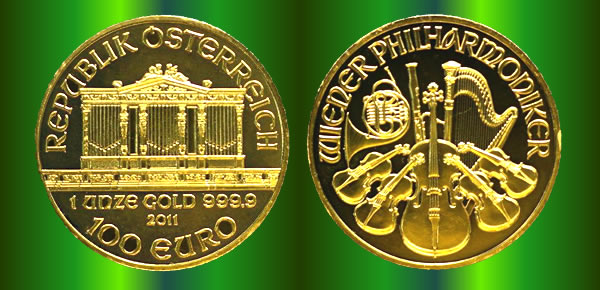
Austria issued this mini-sheet of two stamps in 2014 to mark the 25th anniversary of the issuance of a Vienna Philharmonic gold coin. Both stamps are round when removed from their selvage. The blue (70 eurocents) features the organ in the Gold Hall and the red stamp (90 eurocents) shows various orchestra instruments. The stamp images are replicas of the coins obverse and reverse and utilize gold foil. The coin was issued in 1989 and is one of the most popular gold instruments in the European Union; Autria Post notes it is also very popular in Japan. The coins are known for their purity and exist in various denominations, including a silver coin. Though the stamp is marking the coin's issuance, the organ included on both stamp and coin is remarkable. Here is updated information from the Musikverein on the instrument. More images and a stoplist can be seen here.