Showing posts with label Austria. Show all posts

Friday, January 15, 2021

Guinea: German and Austrian Composers


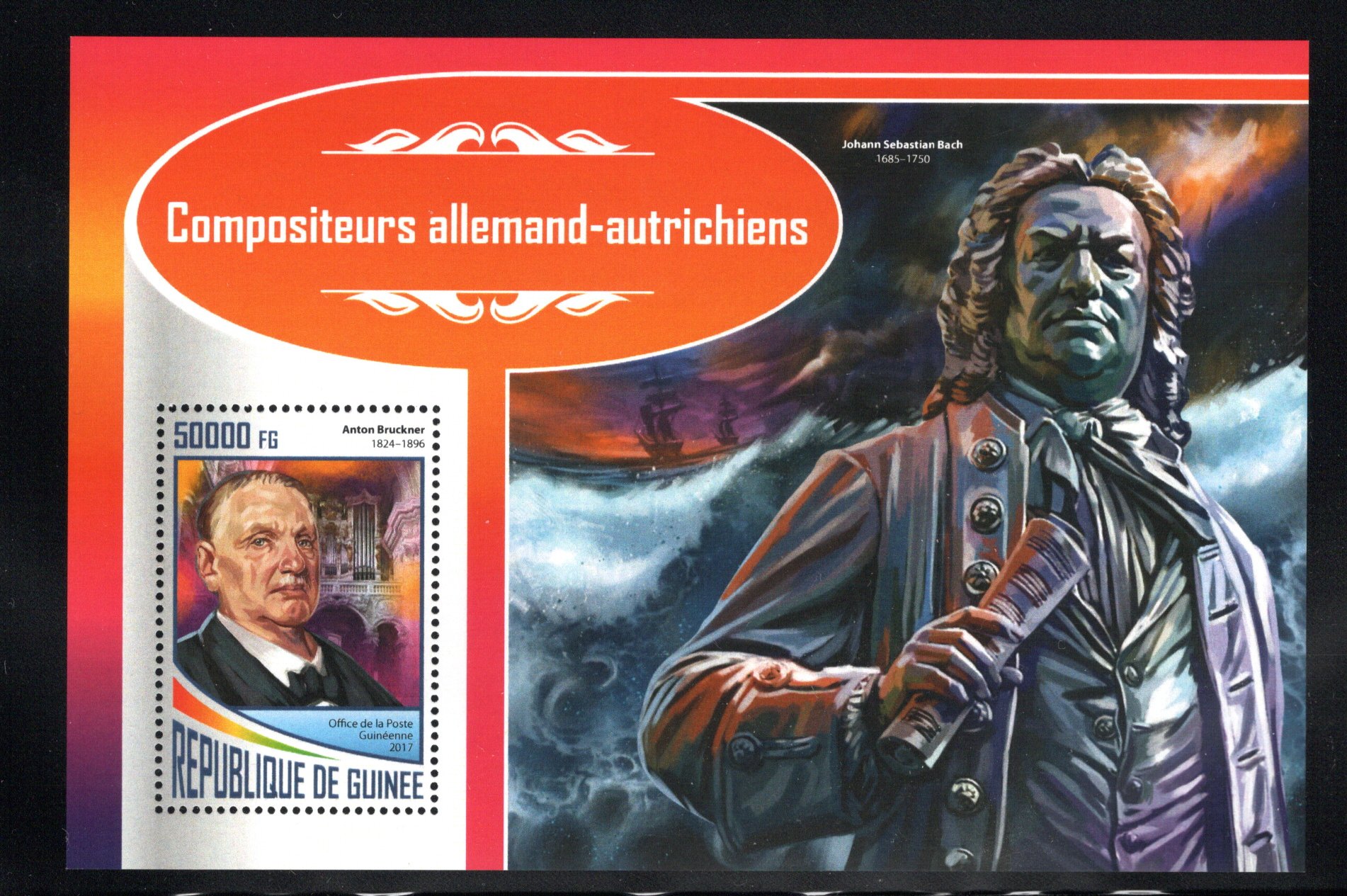
Guinea issued a mini-sheet and a sheetlet of four stamps commemorating German and Austrian composers in 2017. The sheet of four stamps includes images of Beethoven, Mozart, Haydn and Schubert. The mini-sheet shows Anton Bruckner. An organ is in the background of the Bruckner stamp.

European colonizers divvied up the African continent savagely in previous centuries. Portugal, France and Spain all laid claim to areas that included the name "Guinea." The region was a major source for gold which is why it was important to the colonizers. After the various colonies gained independence they took various names: the Spanish region became Equatorial Guinea, the Portuguese region became Guinea-Bissau; French Guinea became simply Guinea. Thus these stamps are from the formerly French region, and include French on the stamps and use francs for the denominations.

Anton Bruckner is closely associated with the St Florian Church in Austria. He has been interred in the church's crypt since his death. The organ pictured on the stamp seems to be that of the St Florian church. Rather than a larger picture of Bruckner in the selvage of the sheet as is often done with this sort of stamp issue, an image of JS Bach is shown.

The organ was built in the 16th century by Franz Xavier Chrismann of Slovenia. It presently has more than 7000 pipes.


Thursday, March 19, 2020

Austria: Nico Dostal

Austria issued a set of 2 stamps honoring composers of operettas in 1995. The 6 shilling stamp showed Franz von Suppe and a scene from "The Beautiful Galathea." The cover above shows Nico Dostal and a scene from his operetta, "The Hungarian Wedding." The stamp in this case is not the stamp-related item, but rather the postmark. It is a commemorative postmark dated April 26 1996,  about one hundred years after the death of composer Anton Bruckner. Better known for his non-organ compositions, Bruckner did produce a handful of organ works with which many organists are familiar. The postmark includes an image of the composer along with some representative pipes. While I have not investigated, I suspect there is no (strong) relation between Dostal and Bruckner, nor between Dostal and the pipe organ. Sergio Berti is the name of a stamp dealer in Italy with whom I have dealt some in the past, though this cover itself was a gift from Mark Jameson.

Thursday, December 27, 2018

Austria: Dostal and Bruckner


This cover is interesting in a couple of ways. Primarily, it has a nice Bruckner commemorative postmark that includes some organ pipes. But curiously the stamp (Scott 1687) is commemorating a composer known for his operettas, which was issued in 1995 (September 15), while a stamp for the 100th anniversary of the death of Bruckner was issued a few months later on 26 April 1996. I am reminded of a scene in a television show in which a character tries to get a famous person's signature on an item not at all related to said person, for the curiosity factor, to confuse future generations. That's what this cover does for me. I've discussed Bruckner and the Austrian stamp related to him in other posts.

Salzburg: Oberndorf bei Salzburg, Stille Nacht Church


This cover marks Christmas 1982 in Oberndorf bei Salzburg, Austria, and a new organ for the St. Nicholas Church there. The church is most famously associated with the creation of the "Silent Night, Holy Night" Christmas carol. However neither the church of that era (1818) nor the organ of legend exist now.

In 1982 the church got a new organ built by the Rieger firm. It is this organ which is commemorated on this cover from that same year. The new pipework was installed in casework from an earlier instrument of 1912. The stamp on the cover (Scott 1228) shows a creche scene from 1630 found in Vorarlberg.


Obviously this is not the instrument was is part of the "Stille Nacht" legend. A church in Oberndorf is first documented in 1160. However a fire in 1769 destroyed that church along with many other buildings. Reconstruction began right away in 1770 and was completed in 1798. Because of problems with river flooding over the next several years plans were made to demolish the church and move it to higher ground. This was done finally in 1906. Whatever organ was in the church at the beginning of the 1800's, by 1821 the Tyrolian builder Karl Mauracher declared it was mostly useless. This is just a few years after the Christmas Eve debacle (non-playing organ in 1818 which led to the creation of the famous Christmas carol). The instrument was sold off and ultimately discarded by the new owners, and replaced at St. Nicholas Church in 1825 by an instrument built by Mauracher. Franz Gruber, organist in 1818, was able to play this instrument during the latter part of his tenure (1816-1829).


Austria: Millstatt Organ Music Week


The town of Millstatt, Austria is probably best known for its Abbey. The Abbey in turn is highly regarded for its emphasis on arts appreciation and music appreciation. Since 1981 it has sponsored a series of music weeks including an Orgelmusikwochen. This cover includes a postmark that celebrates the organ music week in 1981. The postmark includes a row of organ pipes. One of the instruments available for concerts in Millstatt is an 18th century "chororgel." A section of its facade may have been the inspiration for the postmark's design. The abbey church's construction was begun in the 12th century; the onion domes were completed in 1670. The stamp itself is fairly common, from a series issued 1973-1978. This one (Scott 963) shows the Bishofmuetze area near Salzburg.


Saturday, August 11, 2018

Austria: Philharmonic gold coin

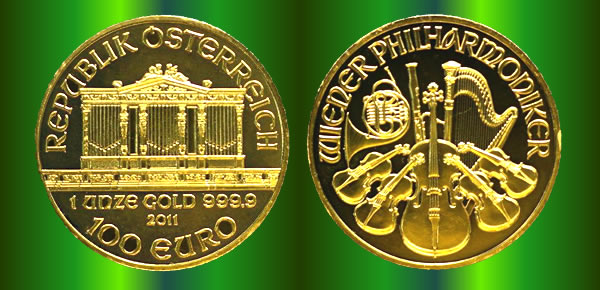
Austria issued this mini-sheet of two stamps in 2014 to mark the 25th anniversary of the issuance of a Vienna Philharmonic gold coin. Both stamps are round when removed from their selvage. The blue (70 eurocents) features the organ in the Gold Hall and the red stamp (90 eurocents) shows various orchestra instruments. The stamp images are replicas of the coins obverse and reverse and utilize gold foil. The coin was issued in 1989 and is one of the most popular gold instruments in the European Union; Autria Post notes it is also very popular in Japan. The coins are known for their purity and exist in various denominations, including a silver coin. Though the stamp is marking the coin's issuance, the organ included on both stamp and coin is remarkable. Here is updated information from the Musikverein on the instrument. More images and a stoplist can be seen here.

Saturday, March 5, 2016

Stockerau, Austria: Pfarrkirche


This cover is interesting for the special postmark. It includes a representation of the organ in the Pfarrkirche in Stockerau, Austria. In 2000 the church celebrated the 275 anniversary of the church tower. Said tower is the tallest, at 88 meters, in Lower Austria. Anniversary celebrations took place in late 2000, culminating according to the postmark on December 1.


The postmark features the organ, the tower, some choristers and a Christmas tree along with stars. This cover has two imprints of the postmark, one each for the postage stamp and for the meter stamp covering additional postage costs. The cover is addressed to someone in Spain. The cover contains the additional notation "drucksache" which means simply "printed matter."

The stamp on the cover is a fairly common stamp of Austria. Part of a set of ten, Scott 1601 is from a set of 10 stamps featuring art from various monasteries in Austria. The present stamp has a sample of stained glass from the Mariastern-Gwiggen monastery in Voralberg. The glass depicts St. Benedict of Nursia. There is in the lower right corner a small rendering of the monastery itself. The stamp was issued in 1993. I can determine no specific relationship between any element of the stamp and the postmark.

The organ was built in 1888 by Johann M. Kauffmann. It is a fairly modest instrument of 25 ranks over two manuals and pedal. The registry does not indicate if and when any repairs, rebuilds or restorations have been done on the instrument.


Also among the items given me by Mark Jameson was this postmark "sampler." It seems to be a 1/2 shilling postage label that has been cancelled by the same postmark. Perhaps one has to pay a token amount for a copy of the postmark; or perhaps it cannot be provided unless tied to a postage indicia of some type. Anyway, another example of the postmark.


Saturday, January 2, 2016

Austria: Musikfreunde


Austria issued this stamp 1 January 2012 commemorating the Gesellschaft der Musikfreunde in Wien (Association for the Friends of Music in Vienna) and its 100th anniversary. The round stamp is striking for its gold-colored central image sharply contrasting with the red border. The stamp was issued as a single stamp in a mini-sheet, denominated 90c. The stamp shows the organ in its gallery in the Musikverein in Vienna, the organ facade and a nude female figure from the casework. This instrument has been on Austrian stamps before. This then would be the new Rieger instrument installed within the original case in 2011-2012. This article discusses the instrument in detail. Rieger gives some additional information and pictures here.

Friday, March 22, 2013

Austria: St Stephen, Stockerau


I recently received this envelop from a friend. The item of interest is the postmark. It features the 19th century organ at St Stephen's Church, Stockerau Austria. It seems the organ was built in 1888 by Johann Kaufmann of Vienna. I have not been able to find a modern image of the instrument. But I believe this is the stoplist. The image below is from the church's website. In the background one can see the organ. I believe there is enough of the instrument showing to declare it a match to the envelop image.


As I mentioned, it is not the stamp on this cover that is of interest, but rather the postmark. It is used to cancel the stamp as one would expect. But it also appears again on the left side of the cover. It seems the postmark was created to celebrate the 275th year of the church's tower. It was produced December 1, 2000 for the Christmas season. In the US an entity may petition the USPS for permission to produce a special postmark for an event of limited scope. Usually the postmark is used for a limited time, and within a limited area (a single ZIP code). I'm not sure how things work in Austria, but because of conventions of the Universal Postal Union, I suspect similarly.

The 6 shilling stamp (Scott 1606) is a detail of a stained glass window located at the Mariastern-Gwiggen Monastery. The script above the male figure seems to read "Sanctus Benedictus." The figure is holding a bishop's crozier and a communion chalice. A building in the lower right corner may be the monastery itself. There is a second stamp of some sort on the left side of the cover. It seems to be a 50 groschen surcharge, perhaps to pay for the special postmark? The cover was sent to Spain. Eventually wound up in the hands of my colleague Mark Jameson in Britain, and now to mine. All in all a nice piece of organ information.

Elsewhere on the church website, I found this image of the console. Without looking at every image on their gallery, I still haven't found the complete instrument; plenty of pictures of the east end however!


Saturday, February 16, 2013

Austria: "Silent night, holy night"


 Austria issued Scott 558 in 1948 to commemorate the 130th anniversary of the composition of the Christmas carol "Silent Night, Holy Night." The stamp features the tune's composer and the lyricist, Franz Gruber and Josef Mohr. The background design may be intended to represent organ pipes. Instead straight, erect pipes, they are curved or undulating, but the design does seem to include pipe mouths.

Mohr had composed the lyrics of the carol in 1816 when he was in Mariepfarr. In 1818, now living in Oberndorf, he asked Gruber to compose a melody and guitar accompaniment. There is plenty of folklore about why guitar accompaniment instead of organ; we'll likely never know the facts surrounding this choice. The song was first performed at a midnight mass on Christmas Eve 1818. The St. Nicholas Church, site of the first performance, no longer exists as it did originally. A memorial church stands in its place.

Friday, April 1, 2011

Austria: Brahms

Austria issued this stamp in 1997, commemorating the 100th anniversary of the death of Johannes Brahms. This is no organ, pipework nor console included on the stamp, not the selvage. But Brahms is a rather important composer of works for organ. Thus I felt this stamp merited inclusion in this blog. I am actually practicing the Chorale-Prelude and Fugue on O Traurigkeit by Brahms for an upcoming concert.

Saturday, January 31, 2009

Austria: Hofhaymer

This stamp was issued 11 September 1987 to commemorate the 450th anniversary of the death of Paul Hofhaymer (Hofhaimer) and Austrian composer. The stamp calls Hofhaymer a composer and organist. The image features the composer playing a positiv organ (a table top instrument of relatively few notes and pipes). Several sources remark on his remarkable improvisational skills at the organ.

Austria: Vienna Philharmonic


This stamp was issued 28 March 1967 to commemorate the 125th anniversary of the founding of the Vienna Philharmonic Orchestra. Scott 789 includes an organ facade, a violin and laurel leaves. The facade is not clear. The Phil plays usually in the Golden Hall of the Music Academy, but that is not the facade include on this stamp. This could be the organ at the Schlosskapelle in Schoenbrunn. Here is information on that organ. I don't know if the Phil ever plays at Schoenbrunn, and if not why this facade might be on the stamp. If you can help identify this facade for certain, please contact me, so I can have the correct information here.

Sunday, April 1, 2007

Austria: Catholic Church Music Congress

This stamp (Scott 596) depicts the organ at the St. Florian abbey, of Anton Bruckner fame. The stamp was issued in conjunction with the Second International Congress for Catholic Church Music, held in Vienna in 1954.

Austria: Albrechtsberger


This stamp was issued Janury 31, 1986 to commemorate the 250th anniversary of the birth of Johann Georg Albrechtsberger. Albrechtsberger was born in Klosterneuburg, near Vienna in 1736. As church musician he worked in Raab and Maria Taferl. He ultimately was kapellmeister at the St. Stephen's Dom in Vienna. It is hard to determine which organ is depicted in the background of the stamp. The stamp depicts only part of the facade of an instrument. However it looks very much like the complete facade shown below. It seems to be the instrument in Klosterneuberg, built by Freundt in 1642.  The abbey is an Augustinian house on the Danube river.

Notes from 2012: This site has a nice history of the facility and the organ. (The developer of the site sadly died in February 2012; his site is wonderfully detailed, with many videos of the organs he covers.) Here is a specification since 1990 after work by Kuhn of Manndorf, Switzerland:

Ruckpositiv (I)
Nachthorn        8
Prinzipal          4
Klein Copl       4
Spitzfloeten     4
Octave             2
Superoctav       1 (3)
Cimbal scharf  ¼ (3)
Krummhorn     8 (2)

Hauptwerk (II)
Principal          8
Principalfloten 8 (6)
Copl                 8
Quintadena      8
Octav               4
Octav Copl      4
Dulcian            4 (3)
Offne Floeten  4
Quint               3
Superoctav      2
Mixtur             4, XII-XIV (3, 6)
Cimbel gross   2/3 (3)
Dulcian          16 (1, 6)
Pusaun             8 (1, 6)

Brustwerk (III)
Coplfloeten      4
Prinzipal          2
Spitzfloeten     2
Regal               8
Tremulant (4)

Pedal
Prinzipal          16 (5)
Subbass           16 (6)
Octav               8
Choralfloeten   8
Superoctav       4
Mixtur              4, VII-VIII
Rauschwerk     2, III
Grosspusaun    16 (1, 6)
Octav Pusaun   8 (1, 6)
 
1990 Installation: 1
1984 Installation: 2
1950 Installation: 3
1934 Installation: 4
With an extra key B below low C: 5
Activated/Deactivated ventil stop “Wind Hinterladen”: 6

Austria: Music Academy


Austria issued this stamp (Scott 864) on June 5, 1970. It depicts the organ in the Great Hall at the Vienna Music Academy. 1970 was the centenary of the building's construction. This site gives several pictures of the organ, but does not give a stoplist, nor the name of the builder.


Update as of 4/2011: Reiger has built a new organ within the pre-existing case. They have a specification here. This discussion board reveals that the original organ was by Ladegast, completed in 1872. The new instrument has 84 ranks at a cost of $1.8 Euros. If the board information is correct, the inaugural concert should have been held recently. The work has been going on since 2010.


Friday, March 30, 2007

Austria: Bruckner Organ


This stamp was issued 26 April 1996 to commemorate the 100th anniversary of the death of Anton Bruckner (1824-1896). Bruckner was long associated with the St. Florian Abbey in Linz. The organ there is today lovingly called the "Bruckner Organ." The organ dates as far back as the 15th century. The current instrument was begun by Franz Xavier Krismann in 1770. At its completion then, the instrument had 74 ranks of pipes. Work continued over many years with several builders adding their imprint to the instrument. It currently has four manuals plus pedal and includes nearly 100 ranks of pipes.

Austria: St. Stephen's


Issued on 12 December 1946, this stamp is from a set of 10 semi-postal stamps. The additional price paid for each stamp aided in the reconstruction of the St. Stephen Cathedral in Vienna. There are actually currently three organs in the Dom: a choir organ from the 1950's; the west gallery instrument most recently updated in the 1960's, and a large instrument from 1991 in the nave. The instrument shown on this stamp is an older version of the west gallery organ, originally built in the 1880's by Walcker.  The organ is located in the west gallery and was re-built by the Kauffmann firm in 1960.
Shown at the bottom is the nave organ built by Rieger.