
Showing posts with label festival. Show all posts
Showing posts with label festival. Show all posts
Monday, September 24, 2018
Romania: Fall Music Festival

Sunday, September 16, 2018
Poland: Koszalin Music Festival

Koszalin is a town in central Pomerania. It along with seven other towns hosts an international organ festival each year. Concerts of organ music, various chamber ensembles, and choral music make up the event each summer. The 52nd series was held in 2018. This card was issued to mark the event in 1972. The postcard stamp image shows a sailboat, definitely not organ-related. But the postmark includes a row of organ pipes. The card appears to have been issued in 1971, and cancelled to promote the music festival the following summer. Address details make up the obverse; my copy is in mint condition, so it's blank on the reverse. This was a gift from Mark Jameson.
Poland: Kamien Pomorski Music Festival

ochrona zabytkow
baszta siedmiu peaszczy XIII w.
zamek ksiazat pomorskich
protection of monuments
Szczecin: bastion of seven coats 13th cent.
Pomeranian Dukes' Castle
The castle dates from the 13th century.
What makes the card interesting to me is the commemorative postmark, celebrating the beginning of the International Organ and Chamber Music Festival in Kamien Pomorski. The medallion in the center of the postmark shows organ pipes in the UR corner. The postmark is dated 17 June 1977. So the card was issued (as part of a series highlighting the need to protect national monuments) to mark the Duke's Castle in Szczecin, and the music festival in nearby Kamien added a fancy postmark to celebrate the music festival in 1977. Text running in the middle of the card would indicate the card was issued by Polish Post that same year, 1977 (a print run of one-million copies, perhaps?). The reverse of this card has a couple of pencil markings made by the dealer selling it, but otherwise the card is blank. It was a gift from Mark Jameson.

Cathedral organ, Kamien Pomorski
Poland: Organ Chamber Music Festival

This site provides some information about the music festival and give a bit of information about the organ in the cathedral.
In the years 1669-1672, the monumental organs were built in the Kamienna shrine from the foundation of Pomeranian prince Ernest Bogusław Croy. They belong to the most famous in Poland. The wonderful sound of this extraordinary instrument (47 voices and 3300 pipes) can be heard during the annual International Festival of Organ and Chamber Music, organized throughout the summer. The concerts start at 19.00 always on Fridays, starting from the last Friday of June to the first Friday of September.
The cathedrals website gives just a bit more information about the organ.
1669-1672 Construction of present organs according to Breyer's instructions from Stargard, then built by M. Berigel, repaired in the early 18th and the beginning of the 19th century. A new instrument built in 1888 by B. Gruneberg from Szczecin, keeping the baroque prospectus.
I have not been able to to find a stoplist anywhere yet. The card shows hands playing an instrument with more than one keyboard, representing an organ. There are no pipes nor any other content on the card. The reverse in black, presumably for the card-writer's message. This card was a gift from my friend in Great Britain, Mark Jameson.
Monday, January 9, 2017
Masevaux, France

St Martin Church in Masevaux burned in 1966, destroying an historic Callinet organ from the mid-1800's. The church committed to rebuild, including two instrument (choir area and rear gallery) for the new facility. The 2016 season was the 40th of this august festival series.
The gallery organ was built by Alfred Kern and completed in 1975. This is the instrument shown on the cover.

Friday, April 17, 2015
Romania: organ cover
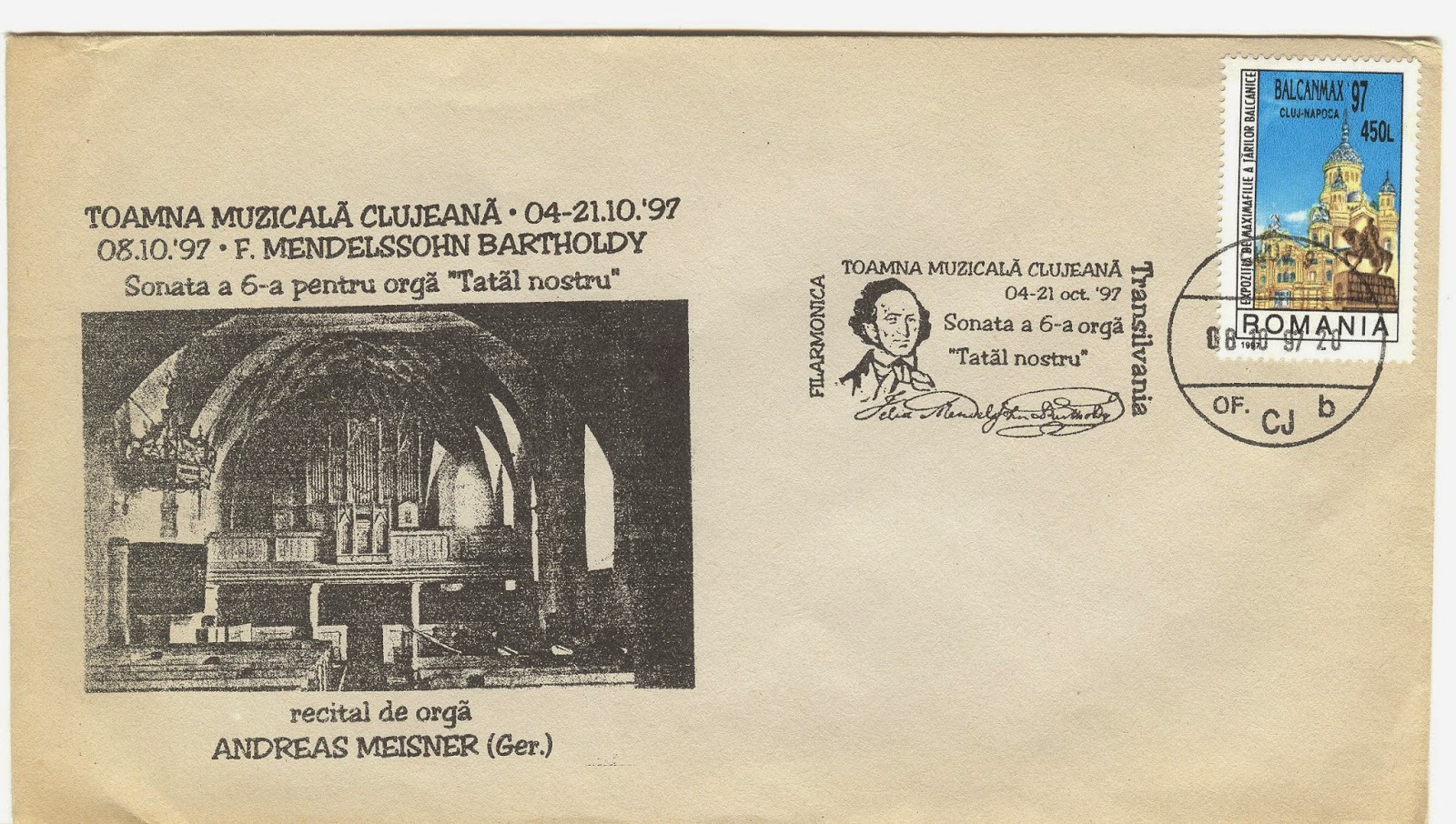
This cover doesn't have a pipe organ stamp, but rather includes a detailed photograph of an organ in an illustration on the left portion of the envelop. In philatelic parlance this is a cachet. Using Google translate I get "musical autumn." "Clujeana" doesn't translate, maybe because of missing diacritical markings. It may be referring to Cluj-Napoca, Romania, the second largest city in that country, and a possible site for a major autumn concert series. The third line of text specifically mentions the sixth Mendelssohn organ sonata, the one in which the chorale "Vater unser" features prominently. Below the image, the recitalist, a German, is named. It would seem the venue/sponsor of the recital went to a great deal of trouble to publicize the event. One wonders if other covers feature other concerts from the autumn season concert series. The postmark includes the same copy as the cachet, but also includes an image of Mendelssohn and his signature. The stamp itself (Scott 4159) is also from 1997, and depicts a monument and a cathedral, issued for a maximum card event that year, Balcanmax. Maximum cards are a rarified form of philatelic endeavore in which the stamp, the postmark, and the postcard or envelop all share a common theme or design element. In this case, the postmark and cachet are thus united, but the stamp foils the effort. Nonetheless, it's a nice piece of organ ephemera and a nifty way to publicize an organ recital. Without knowing the name of the building in which this pictured organ is located, I have not yet been able to track down more specific information about it. The postmark mentions the Transylvania Philharmonic orchestra, which is based on Cluj. If one could ascertain the venues in which they may perform, one may learn which organ this is.
Subscribe to:
Posts (Atom)


