Saturday, April 25, 2015

Wallis and Futuna: Schweitzer


Wallis and Futuna issued this stamp (Scott #330) in 1985 honoring Albert Schweitzer. While the doctor's relationship with Africa is well-established and -known, I am curious about his appearance on the stamp of a Polynesian country. The stamp appears to have been issued to mark the 20th anniversary of his death. Perhaps it is Schweitzer's relationship with France itself which prompts his appearance on the stamp of a French territory stamp.

In any case, the doctor's image is shown on the stamp, along with that of an unidentified boy. The boy's features are imprecise such that he may be intended to represent youth of Wallis and Futuna, or perhaps youth of Africa. The boy is wearing a necklace which to those knowledgeable in such areas may provide clues as to his ethnicity. Some plant life is shown in the background, as well as a (church?) stained glass window and some organ pipes arranged in a round facade feature. We cannot know the site of the window nor organ, or if they are simply non-specific artistic representations.

I have a document that lists all the pipe organ stamps that I am aware of. It includes information that was in an old list developed by a member of the American Topical Society many years ago. The notes for this stamp include "Strasbourg Cathedral organ." A quick look at various images of the organ in the Strasbourg Cathedral reveals that the pipes on the stamp _could_ be from the cathedral organ. But the correlation is tenuous at best. There simply is not enough context provided with the stamp image to know for certain. I'm going to maintain my designation as "unidentified."

Wallis and Futuna: Ronsard


Wallis and Futuna is a French-related island nation in the Polynesian region of the Pacific Ocean. It has had a complicated history. For several years it was a "French overseas territory." Since 2003 it has been termed a "French overseas collectivity." The land area of these islands is barely 50 square miles; the population is around 12,000 persons.

The present stamp was issued in 1985 (Scott #329), 300 years after the death of the stamp's subject, Pierre de Ronsard. Ronsard was a French poet. He is best known for his "love poetry" and his masterful use of language and meter.

The stamp features an image of Ronsard, in silhouette, super-imposed over a compelling drawing. A woman is standing at a table of some type, and is shown playing a positiv organ. A man's face peers over the row of pipes. He may be manipulating the pump for the organ, or perhaps is merely a listener to the music. A curious face (human or animal?) is placed before the table, on the border between the silhouette of Ronsard and the drawing of the woman and organ. I suspect the drawing is an illustration of a scene from one of Rosard's writings. But as I am not at all fmailiar with his oeuvre, I cannot but suppose. There doesn't seem to be any relationship between Ronsard himself and music, let alone the organ. Perhaps someone more familiar with his writings can clarify if this may be a scene from one of the writers works.

Tuesday, April 21, 2015

Canadian International Organ Competition

I had a nice note today from Alexia Jensen with the Canadian International Organ Competition. They happened upon this blog recently and asked if I could add a link for the CIOC at the bottom of the page. Of course I am glad to do so. From their website:

http://www.ciocm.org/uploads/Image/logo_OFFICIEL2.pngThe Canadian International Organ Competition (CIOC) promotes organ music namely by increasing public awareness and interest for this music.

The CIOC presents, every year in October, a festival with some of the world's finest organists. Every third year, the CIOC organizes an international competition in which a prestigious jury representing various countries awards important prizes to a selection of the best young organists in the world.

Seeking to actively participate in the cultural life, the CIOC annually develops a programme of activities in collaboration with various organisations of the organ world; these musical and educational activities are designed to emphasize the cultural importance of pipe organs – treasures of our heritage – for a wide and diverse audience.

Every now and then I hear from someone who has discovered this blog and I am delighted. I am honored the CIOC is interested in promoting this blog in their on-line resources, and am happy to return the favor.

Friday, April 17, 2015

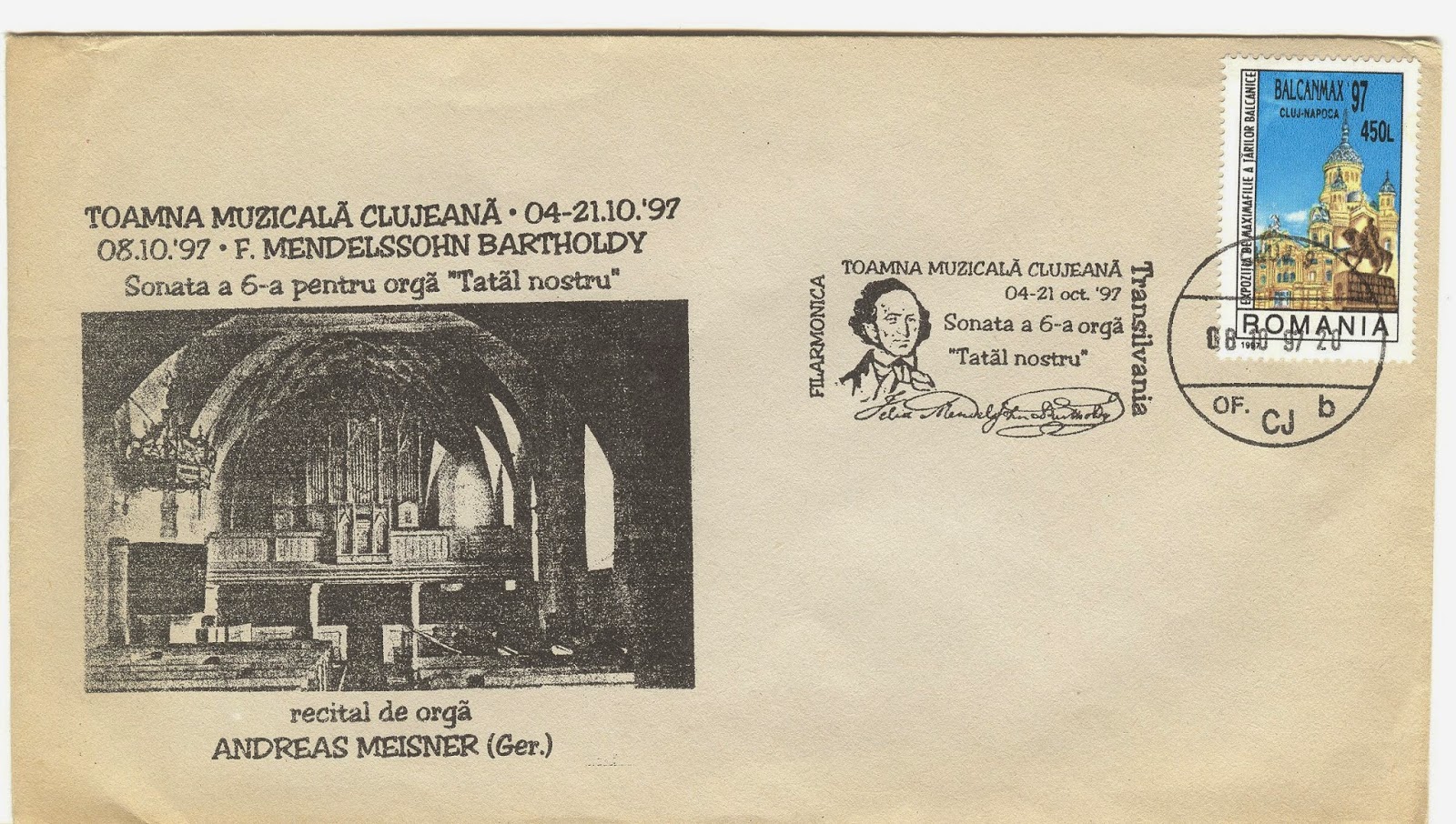
Romania: organ cover

This cover doesn't have a pipe organ stamp, but rather includes a detailed photograph of an organ in an illustration on the left portion of the envelop. In philatelic parlance this is a cachet. Using Google translate I get "musical autumn." "Clujeana" doesn't translate, maybe because of missing diacritical markings. It may be referring to Cluj-Napoca, Romania, the second largest city in that country, and a possible site for a major autumn concert series. The third line of text specifically mentions the sixth Mendelssohn organ sonata, the one in which the chorale "Vater unser" features prominently. Below the image, the recitalist, a German, is named. It would seem the venue/sponsor of the recital went to a great deal of trouble to publicize the event. One wonders if other covers feature other concerts from the autumn season concert series. The postmark includes the same copy as the cachet, but also includes an image of Mendelssohn and his signature. The stamp itself (Scott 4159) is also from 1997, and depicts a monument and a cathedral, issued for a maximum card event that year, Balcanmax. Maximum cards are a rarified form of philatelic endeavore in which the stamp, the postmark, and the postcard or envelop all share a common theme or design element. In this case, the postmark and cachet are thus united, but the stamp foils the effort. Nonetheless, it's a nice piece of organ ephemera and a nifty way to publicize an organ recital. Without knowing the name of the building in which this pictured organ is located, I have not yet been able to track down more specific information about it. The postmark mentions the Transylvania Philharmonic orchestra, which is based on Cluj. If one could ascertain the venues in which they may perform, one may learn which organ this is.


Friday, March 27, 2015

Rwanda: Schweitzer


Like several other African nations, Rwanda holds a special affinity for the medical doctor and musician, Albert Schweitzer. In the year that would have marked his 101st birthday, 1976, Rwanda issued set of stamps to mark World Leprosy Day. A year later the exact same set of stamps was re-issued with an additional text overprint for the same commemoration. The four stamps shown were part of the set of 8 stamps issued in 1977. Two show Lambarene Hospital and two show Schweitzer's residence. Two pictured below show a piano keyboard and a musical score (Bach's famous D Minor Toccata), and the last two in the set are above. The image includes random organ pipes and the first few notes from Bach's Fantasy in G Minor, not as famous or as well-known to as many people as the Toccata, but quite well-known to organists.


Rwanda: "Angels' concert" painting


The African nation Rwanda issued this stamp in 1969 as part of a set of stamps depicting art work with a musical theme. There are 8 stamps in the set including two air mail stamps, but not including two high-value mini-sheets. Other instruments depicted in the paintings shown on these stamps, aside from singers, are a lute, a fife and a piano. This stamp (Scott 281) showing St Cecilia playing an organ is the low value stamp in the set. (This was actually one of the first stamps I ever collected, long before I started playing organ, or focusing my collecting on organ stamps.) Two other angels are playing a harp and a lute in the painting depicted on the present stamp.

The image for the stamp is taken from the Ghent Altarpiece by Hubert van Eyck and his younger brother Jan van Eyck. The younger van Eyck is believed to have completed the work based on his brother's design between 1430 and 1432. The larger work consists of 12 panels, 5 above and 7 below. They together constitute a scene of adoration of the Lamb of God. There are actually two "musical" panels in the upper portion of the altarpiece. The second shows a group of angels singing. The work remains sited in the building for which it was intended: St Bavo's Cathedral, Ghent. Van Eyck has included a great deal of detail in his rendering of the positif organ. The keys are remarkably clear, and light reflects from the metal pipes.


Saturday, September 6, 2014

Romania: Concert Hall


Romania issued this mini-sheet in 2011. It comes after the scope of my Scott catalog, so I don't have a catalog number. There are three stamps in the sheet. The top one depicts Enescu as conductor; the second a musical score; and the bottom stamp shows the exterior of the concert hall facility. The stamps include a "tab" which can be separated from the stamp itself. Each tab shows a picture of Enescu at three ages during his lifetime. The selvage shows the interior of Enescu concert hall, including the state and the organ at the rear. The mini-sheet was issued to commemorate the 20th Enescu International Festival and Competition in 2011.

I found this information at Hans Timmerman's site:
Rechts onder het Walcker-Orgel in de muziekzaal van het Atheneum in Bukarest
Gebouwd in 1939,Opus 2654,III/P 52 registers en 4 transmissies SW-Ped
In 1964 uitgebreid met 2 registers in SW.
De laatste restauratie was in 2007 en uitgevoerd door Gerhard Walcker/Kleinblittersdorf.

With that clue (it's a Walcker Organ) I was able to find more information at the GE Walcker site. This page includes a remarkable reflection on the hall and organ.


Here is wiki-information on the hall:
The Romanian Athenaeum (Romanian: Ateneul Roman) is a concert hall in the center of Bucharest, Romania and a landmark of the Romanian capital city. Opened in 1888, the ornate, domed, circular building is the city's main concert hall and home of the "George Enescu" Philharmonic and of the George Enescu annual international music festival.

The building was designed by the French architect Albert Galleron, built on a property that had belonged to the Văcărescu family and inaugurated in 1888, although work continued until 1897. A portion of the construction funds was raised by public subscription in a 28-year long effort, of which the slogan is still remembered today: "Donate one leu for the Ateneu!"

On December 29, 1919, the Atheneum was the site of the conference of leading Romanians who voted to ratify the unification of Bessarabia, Transylvania, and Bukovina with the Romanian Old Kingdom to constitute Greater Romania.

Extensive reconstruction and restoration work has been conducted in 1992 by a Romanian construction company and restoration painter Silviu Petrescu, saving the building from collapse.


Another mini-sheet has been issued by Romania in 2013, commemorating the 125 anniversary of the hall itself. I don't have the stamp yet, but will create a post on it when I track down an example for myself.