


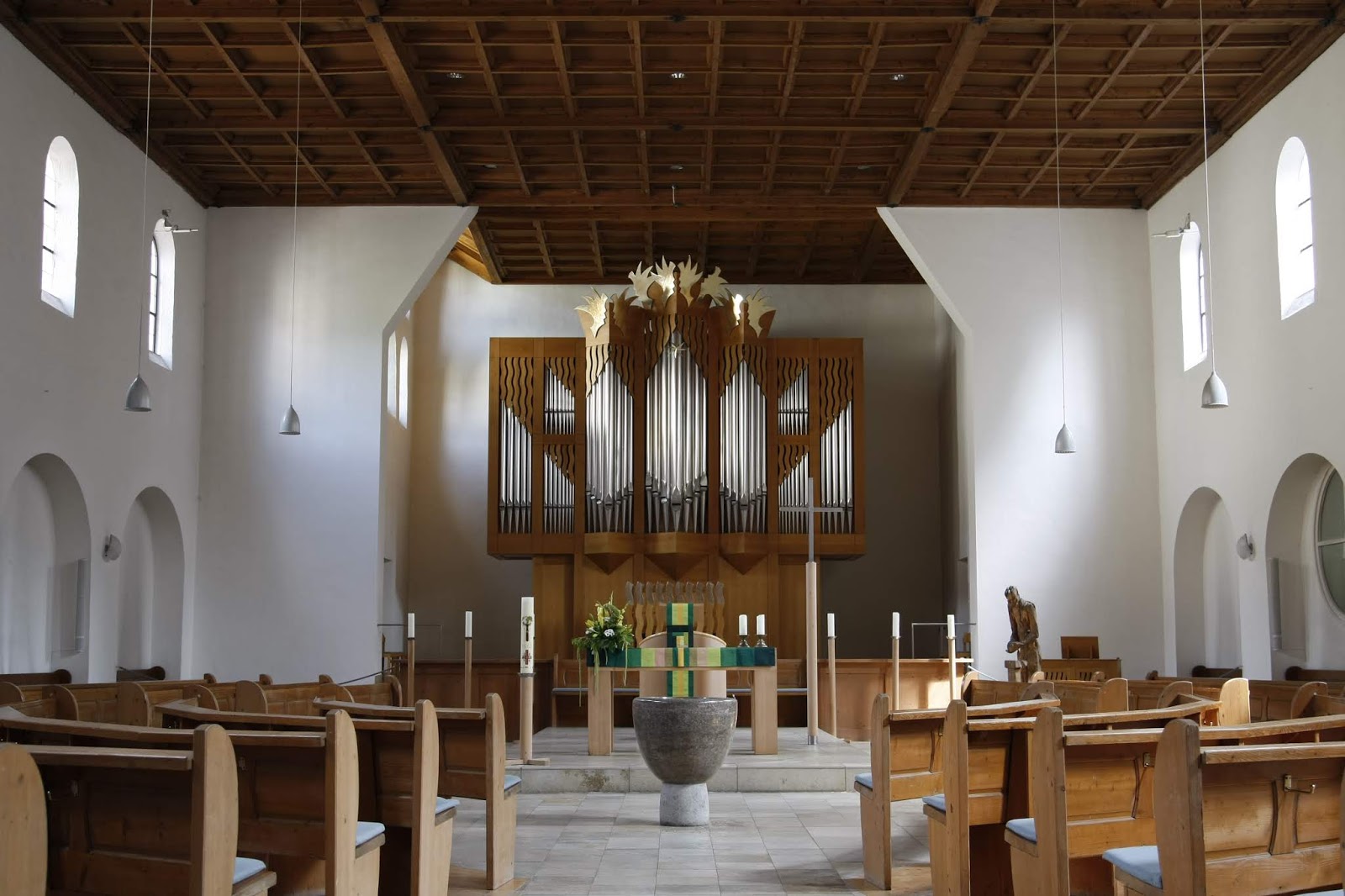
Now noticed the ceiling in the photograph on the left side of the 1988 FDC. I believe they are they same pattern, which was one of the clues that helped me know I was correct in putting stamp and facility together as I worked to unravel this mystery between 2005 and 2013.

One can read details of these keys historical points at the church's website. The church has written about some details related to the Eule organ here. I was able to find the Organ Museum site, but it mentions only a small Nenniger instrument; nothing about an instrument from Ascension Church in Munich.
I am most excited to solve this little mystery. It has taken quite some time, and help from several persons.
Below is Peter Lang's follow-up article. One can use an online translation site if needed.
Im Sommer 2004 erschien im
„Baton", dem Mitteilungsblatt unserer englischen Schwestergruppe ein
Artikel von Michael R. Barker über ein Detail der Berliner Marke Michel 810 aus
der Berliner Serie „Für die Jugend“, die 1988 unter dem Motto „Jugend musiziert“
stand. Michael R. Barker, Organist, Chorleiter und Komponist aus Virginia/USA
sammelt das Thema „Orgel“ und hatte die vermutung, dass im Hintergrund der
graphisch etwas verschwommenen Marke eine Orgel zu sehen ist. Der blaue
Grundton der Marke erinnerte ihn sehr stark an die Kaiser Wilhelm
Gedächtniskirche in Berlin doch Vergleiche zwischen der Marke und Bildern der
Kirche ließen erhebliche Zweifel aufkommen. Nach längerer Suche im Internet
stieß er auf die Anschrift der Münchner Grafikerin Antonia Graschberger und war
sehr erfreut, als er einige Zeit später die Antwort erhielt, dass die Marke
tatsächlich eine Orgel zeigt. Das Photo, das als Vorlage zur Briefmarke diente,
wurde 1987 in der Evangelisch-Lutherischen Himmelfahrtskirche in München Sendung
aufgenommen. Aus dem Bild wurde dann mit Hilfe eines Photomosaik-Verfahrens das
endgültige Markendesign erzeugt.
Da ich mich unter anderem auch für
die philatelistischen Aspekte der Münchner Musikgeschichte interessiere weckte
der Artikel des amerikanischen Sammlers natürlich das Interesse, mehr über
diese Orgel zu erfahren. Wieder leistete das Internet große Dienste, denn nach
einiger Recherche fand ich die Anschrift von Klaus Geitner, dem Kantor der Himmelfahrtskirche.
Er erinnerte sich noch genau an die
Vorbereitungen zur Briefmarke und konnte mir auch Details zu der
abgebildeten Orgel mitteilen.
Das Instrument wurde 1954 von der
Münchner Orgelbaufirma Leopold Nenninger errichtet und wurde damals viel
beachtet, denn es gehörte zu den ersten Orgeln die nach dem 2. Weltkrieg mit
mechanischer Spieltraktur und
Schleifwindladen gebaut wurden. Die Orgel wurde im Laufe der Zeit auf 30
Register auf drei Manualen und Pedal erweitert. Allerdings stellte sich heraus,
dass der Bau einer-mechanischen Orgel in den 50er Jahren doch nicht ganz so
einfach war. Das Instrument wurde mit der Zeit immer störanfälliger, sodass man
ab 1983 Überlegungen zu einem Orgelneubau anstellte. Am 1. Advent 1992 erklang
die auf der Marke abgebildete Nenninger-Orgel in der Himmelfahrtskirche zum letzten
Mal in einem Gottesdienst. Wegen ihrer zeitgeschichtlichen Bedeutung wurde sie
dem Orgelmuseum auf Schloss Valley in Oberbayern übergeben. Seit Juni 1994
erklingt in der Himmelfahrtskirche ein neues Instrument aus der Werkstatt der
Firma Eule in Bautzen.
Klaus Geitner, der auf der
Briefmarke abgebildete Dirigent, wurde in München geboren, er studierte in
München, Augsburg und am Mozarteum in Salzburg Kirchenmusik und Chorleitung.
Weiterführende Kurse belegte er unter anderem bei Nikolaus Harnoncourt. Seit
1983 ist Klaus Geitner Kantor und Organist an der Himmelfahrtskirche in München
Sendung. 1990 gründete er das Ensemble „II concerto piccolo", das sich auf
die Aufführungspraxis des 17. und 18. Jahrhunderts spezialisiert hat.
Alljährlich organisiert er ein umfangreiches und vielseitiges
kirchenmusikalisches Programm und arbeitet dazu mit namhaften Chören und
Orchestern zusammen. Rundfunk- und Plattenaufnahmen sowie Konzerte im In- und
Ausland ergänzen seine künstlerische Tätigkeit.


