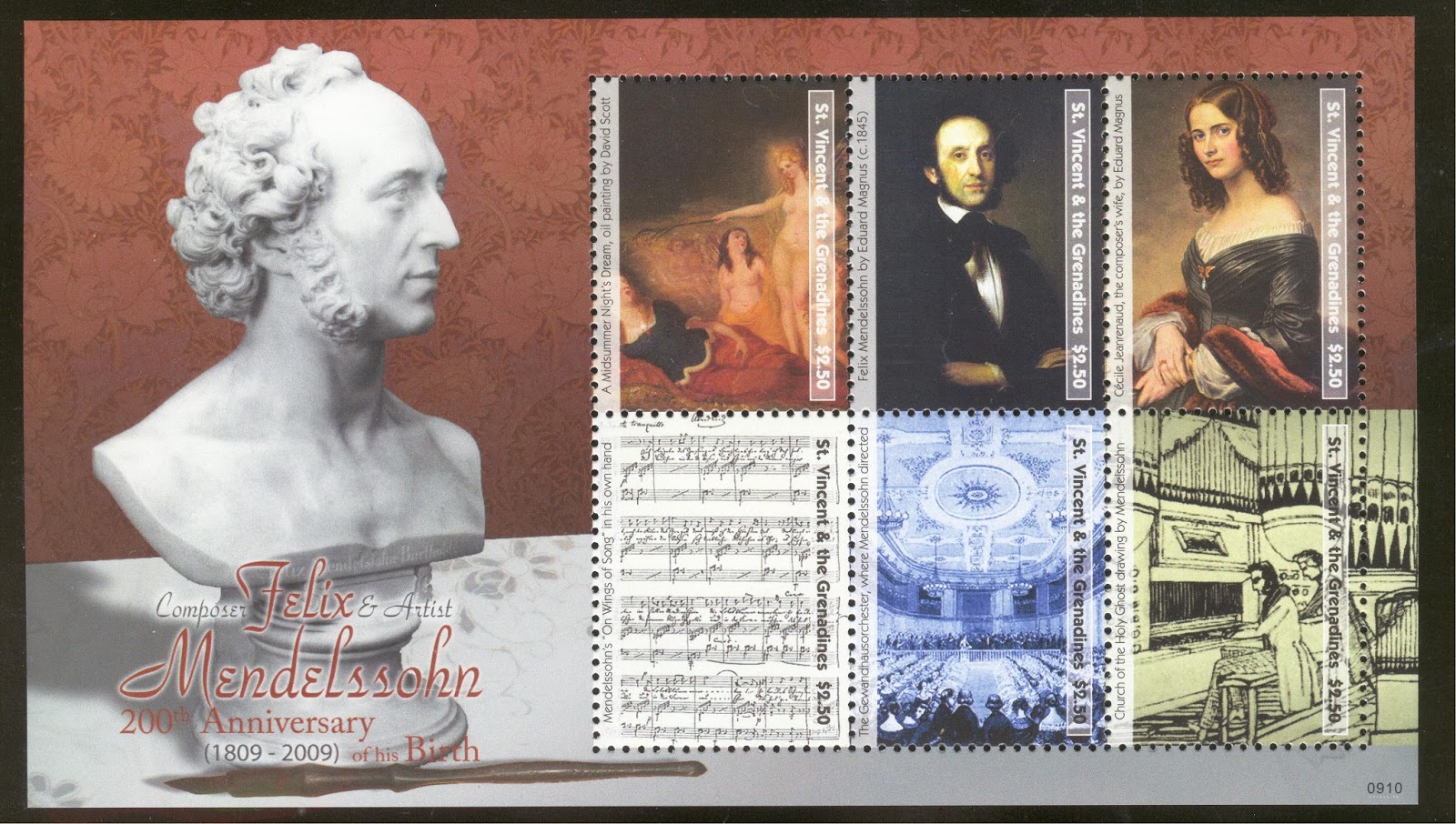
This stamp was issued by St. Vincent & the Grenadines in 2009 the bicentennial of the birth of Felix Mendelssohn. The stamp was part of a mini-sheet of six stamps (Scott 3658) depicting various aspect of the composer's life and work. The present stamp depicts a sketch made by Felix Mendelssohn himself of an organ in Heidelberg Germany. Other stamps depict a painting of a scene from "A Mid-Summer's Night Dream"; a portrait of Felix Mendelssohn; a portrait of Cecile Jeanrenauld Mendelssohn, the composer's wife; a musical score; the orchestra hall where Mendelssohn conducted, and the present stamp. There would be no direct connection between the issuing country and the subject matter.
The organ shown in Mendelssohn's sketch is long gone. This
site tells us 13 instruments have existed in the church over the course of its history. The location has changed too: south wall, west gallery, and a unique instrument that was situated on a sort of rood screen between the nave and choir, which could be played from both sides of the partition! The present organ is by Steinmeyer was constructed between 1980 and 1993 as their opus 2354. It has 61 ranks. The church's
website doesn't give very much more information.
After considerable searching I was able to find some information that sheds light on the sketch shown on the present stamp. Here is the entire passage, minus footnoted material:
In their honeymoon diary Cecile Mendelssohn noted on 8 May 1837 that "before lunch Fritz [Schlemmer] played for us in the church," and later Felix sketched the scene into the diary. Even though Cecile did not identify the church, it has long been assumed that the church in question was the Heiliggeist-Kirche since "it is the principal church of Heidelberg," as as Peter Ward Jones has pointed out, "it was just around the corner from [their] hotel." On the other hand, as Ward Jones has also noted, Mendelssohn's sketch does not depict the interior of either the Heiliggeist-Kirche or any other identifiable Heidelberg church. Moreover, the organ on which Schlemmer is playing in the sketchappears to have but a single manual, although very clearly there is a Ruckpositiv behind him. The figure beside Schlemmer, serving as registrant, appears to be Mendelssohn, and certainly if Schlemmer played, then it can be assumed that Mendelssohn also played. Altogerh, Mendelssohn's sketch presents a number of problems, but as Ward Jones has reasonably concluded, "it may well be that the details were imperfectly recollected."
Mendelssohn and the Organ, William A Little, Oxford University Press, July 1, 2010 ISBN 0195394380 Pages 352-353. Accessed via Googlebooks. Little's helpful book is still in print and available.
Little begins this portion of the Appendix A by noting the location and the instrument, Liborius Muller: III/41 (1815). I have not been able to find information in English about this building nor a catalog of instruments.