Vatican City issued this set of three stamps (Scott 960-962) in 1994 to mark the 13th International Convention of Christian Archeology, which was held in Split, Croatia. The images on the stamps are details from the Euphrasian Basilica in Porec, Croatia. The mosaics depicted are located in the east-end apse of the basilica, and are indeed quite dramatic. The 700 lira stamp shows Bishop Euphrasius, Archdeacon Claudius, and Claudius' son; the 1500 lira stamp shows the Madonna and Child with two angels; the 3000 lira stamp shows Christ and the Apostles Peter and Paul. In addition to the persons on the stamps, the overall mosaic includes all twelve of the disciples of Jesus, plus numerous saints. When this set was recommended to me, I inquired as to the organ "tie-in." I was told that while an organ is not present on any of these stamps, there is an organ visible elsewhere in the mosaic. I have searched for a couple of years now and have yet to find any hint of an instrument, nor pipes, nor even anything like a pan-flute within the mosaic. I am including this post for the sake of completeness, but I am not convinced that there are any pipes, let alone an entire instrument, present in the mosaic. I will be happy to be corrected by anyone who knows better. I have included a couple of detailed photographs of the mosaic for any who wish to explore and seek to discern a pipe or two! I do note that Euphrasius is holding a church building, which may be a representation of the basilica; within the basilica there may be an organ (I have not found information about one yet), and by extension the Bishop is holding a representation of an organ?
Friday, August 17, 2018
Hungary: Esztergom Basilica
Hungary issued this souvenir sheet of a single stamp (Scott 4003) in 2006 to celebrate the 150th anniversary of the Esztergom Basilica several miles northwest of Budapest. The present facility was built atop the site of much earlier religious buildings beginning in 1822. The present edifice was completed and dedicated 1856. It is the largest church in Hungary. The original organ was installed along with the completion of the basilica in 1856, an instrument by Ludwig Mooser. It was a respectable 3-manual instrument with 49 ranks. Istvan Baroti, director of music from 1975-2014 oversaw an ambitious expansion of the instrument, with a goal of it becoming the largest in Hungary, and rivaling the largest instruments in all of Europe. The stamp features an exterior view of the basilica; the selvage shows various elements of the interior. The LL reveals a portion of the organ case and facade pipes.
Maldive Isands: Bach anniversary
In 1985 the nation of Maldive Islands issued a set of 4 stamps plus a souvenir sheet (Scott 1106) of a single stamp in honor of the 300th anniversary of the birth of JS Bach. The stamps all include a portrait and either a piece of music or a musical instrument. The souvenir sheet is a portrait with the St Thomas Church, Leipzig in the selvage. Bach's connection with St Thomas is well-known. The organs contained therein are likewise well-known. The image in the selvage is an older engraving, before the very famous Bach statue was erected on the grounds. Thus the stamp is actually non-organic, but the connection is none-the-less strong.
Saturday, August 11, 2018
Ecuador: Our Lady of Mercy
Ecuador issued this stamp in 1979/1980 as part of a set of 13 featuring the Basilica of Our Lady of Mercy in Quito. (The stamps include the year 1979, but my catalog says they were actually issued in July 1980. The Virgin of Mercy is patron for the armed forces of Ecuador, so the stamps mention that also. I have 10 of the stamps, including the airmails. There is a subset of three which are imperforate and larger in size. I have not yet been able to find them. The stamps feature various indoor and outdoor scenes of the facility. Each stamp includes verbiage which describes the image shown. The present stamp shows a balcony (tribuna) with the lower portion of the organ case. I have not been able to find anymore information about the organ, though I have made inquiries in South America.
Burrundi: Beethoven
Burundi issued this mini-sheet of four stamps in 2011. Mine happens to be imperforate; a perforated version is available. The sheet is called "Composers" and shows portraits of Mozart, Beethoven, Vivaldi, and Chopin. The image of Beethoven includes organ pipes in the background. There is not quite enough detail to the rendering for me to determine if this is a specific instrument or not, and if so what instrument it might be. The sheet's selvage includes more images, presumably of (other) composers, though I cannot determine who they are. LR may be Liszt. UR looks somewhat like the Bach statue in Leipzig.
Austria: Philharmonic gold coin
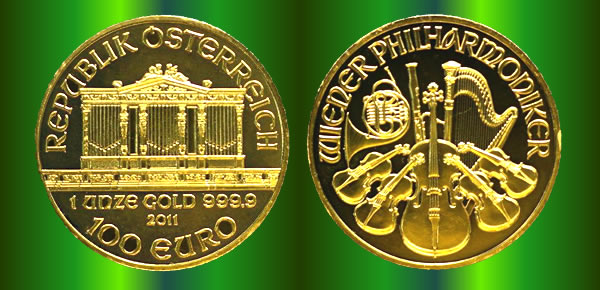
Austria issued this mini-sheet of two stamps in 2014 to mark the 25th anniversary of the issuance of a Vienna Philharmonic gold coin. Both stamps are round when removed from their selvage. The blue (70 eurocents) features the organ in the Gold Hall and the red stamp (90 eurocents) shows various orchestra instruments. The stamp images are replicas of the coins obverse and reverse and utilize gold foil. The coin was issued in 1989 and is one of the most popular gold instruments in the European Union; Autria Post notes it is also very popular in Japan. The coins are known for their purity and exist in various denominations, including a silver coin. Though the stamp is marking the coin's issuance, the organ included on both stamp and coin is remarkable. Here is updated information from the Musikverein on the instrument. More images and a stoplist can be seen here.
Antigua: Bach anniversary
The island nation of Antigua (also Antigua and Barbuda) issued this miniature sheet (Scott 2339) of a single stamp in 26 June 2000, presumably for the 250th anniversary of the death of JS Bach. The sheet shows the Bach statue which is located outside the St Thomas Church in Leipzig Germany. The background is a music image denoted BMV 900. One assumes that should read "BWV" the generally used cataloging nomenclature for Bach works. It's a piano prelude and fugue. Bach was of course music director and teacher at the St Thomas church and school from 1723 until his death. The statue was erected in 1908, built by Carl Seffner. The composer is at the forefront of the statue but behind him is a representation of a pipe organ. It's not very clear on the stamp, but the image below makes it quite clear. Antigua was identified as part of the Leeward Islands for some time; it became a crown colony in 1956 and an Associated State in 1967. It gained independence in 1981 and took the name Antigua and Barbuda.
Subscribe to:
Posts (Atom)